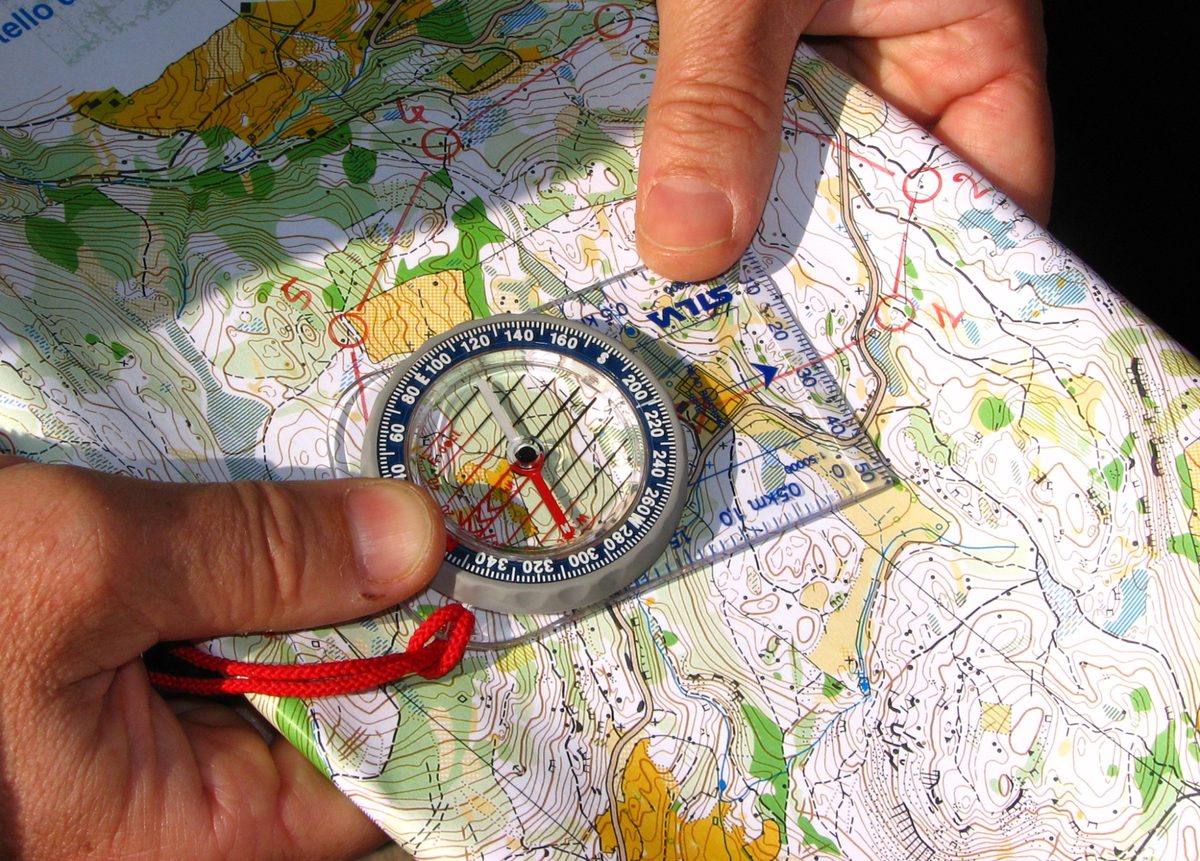
Compass Basics — Activity
Use a compass to go in the correct direction
| Time | 20-30 minutes |
|---|---|
| Space | Gym, schoolyard, or local park |
| Materials | Compasses (1 per student or pair), Maps of the area |
| Vocabulary | Direction, Magnetic north |
"Using a compass correctly is important when orienteering"
- Learning Goals
- How to Run It
- Reflection
- Vocabulary
Learning Goals
Students completing this activity will be able to:
- Develop directional awareness using a compass
- Work out which direction something is from you
How to Run It
Setup
- No physical setup is needed. Have compasses and maps ready to hand out.
Steps
1. Direction. Discuss how a compass always points to magnetic north. Teach a silly acronym for the cardinal directions. Ask students to point in various directions by using their compass (e.g. north, west, southeast).
2. Map setting. Give out maps and demonstrate how to orient the map using the north lines. Turn the students various ways and get them to orient the map to north.
3. Bearings. Ask the students to pretend they are standing at the start triangle and to take a bearing as if they are going to checkpoint 1. Ask them to point in the direction of travel. Check each student is pointing the correct way. Repeat for each checkpoint.
Adaptations
Ways to adapt the activity to meet the needs of your students: slow things down, increase the challenge, or adapt for different learners
- Take bearings: show students how to take bearings using the compass swivel housing
- Straight-line practice: practice walking, jogging, or running in a straight line while staying on the correct bearing
Tips
- Introduce the concept of a safety bearing before participants head out on any course with a compass. A safety bearing is a simple direction they can follow if they get badly lost. For example: "If you are ever completely lost, walk south until you reach the road, then follow the road back to camp." Knowing there is a reliable bail-out builds confidence.
- In orienteering, the compass is primarily used to orient the map, not to take precise degree bearings. Emphasize map-setting over angle-taking for beginners.
Reflection
- How did you ensure you were facing the right direction?
- How did you take a bearing to figure out which direction a checkpoint was from you?
- What is special about the colors on the compass needle?
- How could a compass be helpful when orienteering?
- Did the compass work differently when held horizontally and vertically?
Vocabulary
Direction: A compass direction such as north, south, east, west, or any combination (northeast, southwest, etc.).
Magnetic north: The direction the compass needle points. The north lines on an orienteering map are aligned to magnetic north.
See the Glossary for all curriculum terms.