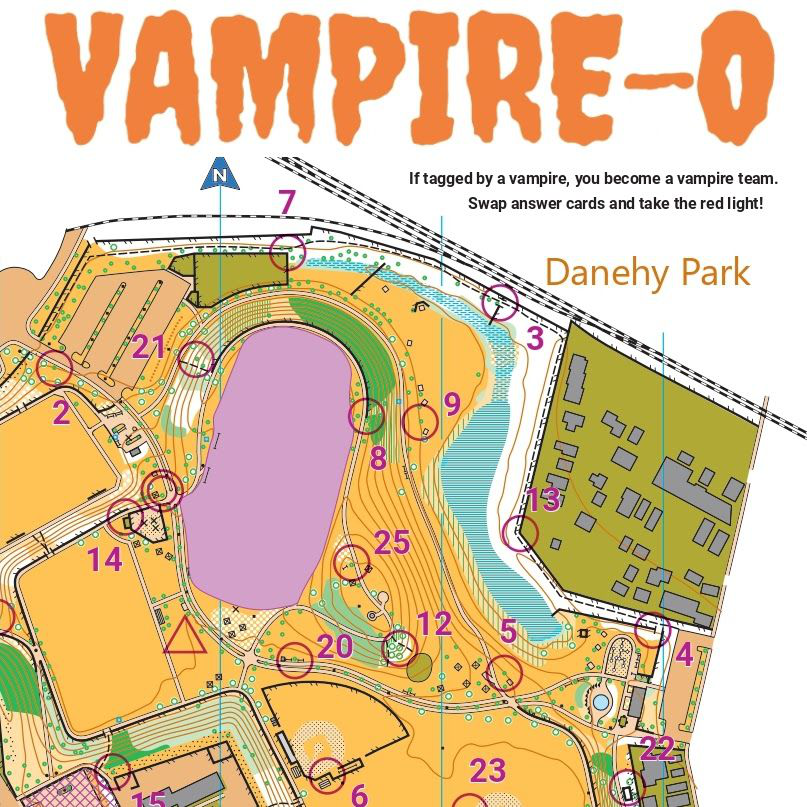
Vampire-O — Activity
Visit all the checkpoints without getting caught
| Time | 30-45 minutes |
|---|---|
| Space | Schoolyard or local park |
| Materials | Checkpoints with punches, Maps (1 per pair), All-checkpoints map (for setup), Punch cards or index cards, Pencils, Holy water (gallon jug of water with food coloring), Wooden cross (two sticks tied together), Garlic necklaces |
| Vocabulary | Checkpoint, Punch card, Vampire |
"Beware, if a vampire catches you, you could lose your progress"
Vampire-O is Score-O with a chase. Pairs visit the checkpoints shown on their map, but one or two pairs start as vampires. When a vampire tags a pair, it takes their punch card, and the tagged pair becomes a vampire team that must tag someone else. Protection items waiting at some checkpoints (holy water, a wooden cross, garlic necklaces) protect the finders from vampires.
The tag layer adds urgency and drama to map navigation. Students must keep reading the map carefully while staying aware of what is happening around them, which is exactly the divided attention real orienteering demands.
- Learning Goals
- How to Run It
- Reflection
- Vocabulary
Learning Goals
Students completing this activity will be able to:
- Identify and understand map symbols
- Check neighboring features to make sure you are in the right place
- Use spatial relationship vocabulary
- Work cooperatively with and accept feedback from others
- Give feedback to peers
How to Run It
Setup
- Place checkpoints according to the all-checkpoints map
- Leave the protection items (holy water, wooden cross, garlic necklaces) at a few checkpoints for the first teams to find
- Prepare a punch card or index card for each pair
Steps
- Pairs receive maps; review the boundary of the play area verbally and have students find it on their maps
- Map warm-up: the teacher describes a checkpoint location; students orient their maps, point to the feature, and raise their hand if it is a circle on their map. Repeat a few times
- Hand out punch cards (or index cards) and pencils
- Assign vampires and explain the rules: vampires try to tag a non-vampire pair. A tagged pair hands over its punch card and becomes a vampire team that must tag another team. Vampires may not guard checkpoints or hover inside a checkpoint circle
- Protection items found at some checkpoints (holy water, a wooden cross, garlic necklaces) protect the carriers from vampires
- Pairs visit each checkpoint on their map, recording their visits, while avoiding vampires
- Score the results: count checkpoints on the cards each team holds at the end
- Reflect together
Adaptations
Ways to adapt the activity to meet the needs of your students: slow things down, increase the challenge, or adapt for different learners
- Fewer vampires and more protection items (holy water jugs, wooden crosses, garlic necklaces) make the game gentler for younger or newer groups
- More vampires raise the pressure for experienced groups
- Night Vampire-O (a camp favorite): play after dark with red flashlights and reflective tape on the checkpoints. Navigation by flashlight transforms familiar terrain
- Rule negotiation: let students propose rule changes between rounds and test them
- Electronic timing: use electronic timing to track checkpoint visits
Tips
- Keep the vampire rules crisp before starting: who can tag, where tagging is not allowed, and what happens to the punch card
- Watch that the tag game does not completely take over. If pairs stop reading their maps, add protection items or reduce the number of vampires
- The punch card trade is the heart of the game. Losing progress stings for a moment, but becoming a vampire is fun, so nobody is ever out
Reflection
- How did you use the map symbols to find checkpoints while avoiding vampires?
- How did you confirm you were at the right checkpoint, even while distracted by the chase?
- What words did you use to describe where a checkpoint or a vampire was?
- How did you and your partner work together and help each other?
- What feedback did you give your partner during the game?
- What did you like or dislike about the game? Do you think we can make it better?
Vocabulary
Checkpoint: A marker placed at a specific location that participants must find using the map.
Punch card: A card where you record proof of each checkpoint visit.
Vampire: A team that tags other teams. If a vampire tags you, it takes your punch card and you become a vampire.
See the Glossary for all curriculum terms.