Lesson 3: Compass and Courses
"The compass always points north"
| Time | 70 minutes |
| Space | Schoolyard, local park, or forested area with an orienteering map |
| Materials | Compasses (1 per student or pair), Orienteering maps (1 per student or pair), Checkpoints (orienteering flags, streamers, or cones), Course maps with numbered checkpoints, Maps of the area |
| Setup | Place checkpoints for a point-to-point course; have compasses and maps ready |
| Vocabulary | Direction, Magnetic north, Bearing, Course |
Activities
core
Compass Basics
Learn to use a compass for direction, map setting, and bearings.
Goals
Orienteering Goals
- Identify cardinal and intermediate compass directions
- Orient the map using a compass
- Take a bearing from the map and point in the direction of travel
- Navigate a course using both map and compass
Delivery
- Safety review (5 min): review boundaries. Introduce the safety bearing: a simple compass direction campers can follow if they ever get badly lost (e.g., "walk south until you hit the road, then follow the road back to camp"). This is the first time campers learn that the compass has a safety function, not just a navigation one. Emphasize that compasses are tools, not toys.
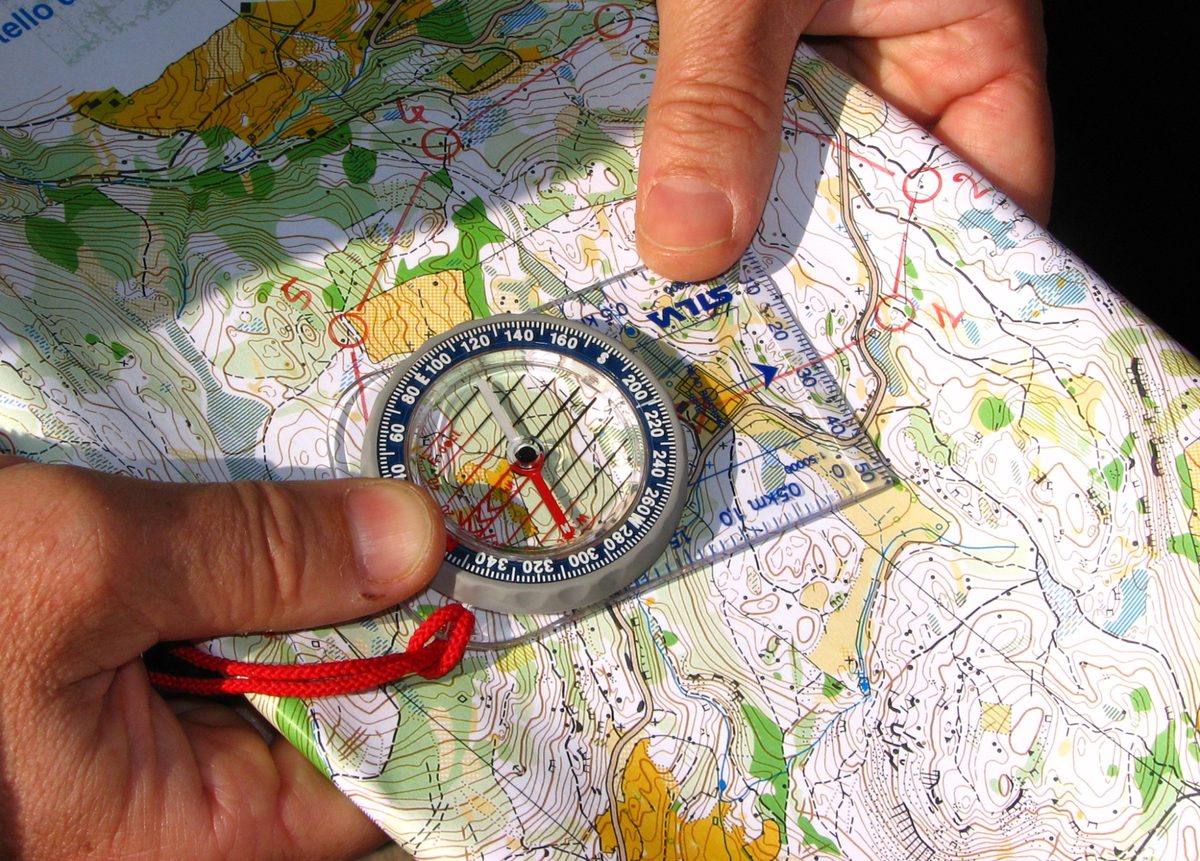
- Compass Basics (25 min): introduce the compass in three stages: a. Direction: the needle always points to magnetic north. Practice pointing in various directions (north, west, southeast). b. Map setting: hand out maps, demonstrate orienting the map using the north lines. Turn students various ways and have them re-orient the map. c. Bearings: pretend to stand at the start triangle on the map, take a bearing to the first checkpoint, and point in the direction of travel. Repeat for each checkpoint.
- Courses (30 min): run an orienteering course, visiting checkpoints in order using both map and compass. Start with a simple course (3-5 checkpoints on clear features) and progress to a longer one. Pairs navigate together: one person holds the map, the other holds the compass.
- Wrap-up (10 min): gather, discuss how the compass helped (or did not help), and share strategies.
Reflection
- How did the compass help you orient the map?
- Was there a time the compass told you something different from what you expected?
- What was your strategy for navigating between checkpoints?
- When is a compass most useful? When can you navigate without one?
Extensions
- Run a second course with more checkpoints or in more complex terrain
- Challenge pairs to navigate without the compass, using only the map
- Time the courses for a competitive element