Lesson 3: Map Readiness
"We use a map to know where something is before we even find it"
| Time | 30-60 minutes |
| Space | Gym, schoolyard, or local park |
| Materials | Checkpoints with animals and numbers, 4 colored landmark cones, Pattern maps, Small whiteboard and markers (or paper), All-checkpoints map, Animal-picture checkpoints, Clue sheets |
| Setup | Arrange checkpoints in a geometric pattern with colored landmark cones at corners |
| Vocabulary | Map, Orient the map, Landmark, Spatial relationship words (next to, closest, furthest, between) |
Activities
warm-up
Animal-O
Warm up: quick Animal-O course to review clue sheets.

readiness
Geometric Readiness
Spatial vocabulary and map orientation exercises.
core
Geometric-O
Orient a simple map and visit checkpoints in order.
Goals
Orienteering Goals
- Understand spatial relationship vocabulary (next to, closest, furthest, between)
- Orient a map using landmarks
- Read a simple map and connect it to the physical space
- Identify and fix orientation mistakes
- Complete progressively harder courses using a map
PE Standards (SHAPE America)
Standard 2: Movement & Fitness Concepts
- Applies movement concepts and strategies for safe movement within dynamic environments (2.5.1). Students orient their maps and navigate to checkpoints using spatial relationships between landmarks.
- Demonstrates problem-solving strategies in a variety of games/activities (2.5.5). Students solve the spatial puzzle of matching map patterns to checkpoint locations in the field.
Standard 3: Social Skills
- Uses communication skills to negotiate roles and responsibilities in a physical activity setting (3.5.2). Navigator and Checker negotiate who reads the map and who verifies checkpoints.
- Demonstrates respectful behaviors that contribute to positive social interaction in group activities (3.5.3). Partners share maps and discuss spatial relationships during Geometric Readiness.
- Solves problems independently, with partners, and in small groups (3.5.5). Pairs work through progressively harder map courses together.
Standard 4: Personal Skills
- Identifies movement strengths and opportunities for practice for individual improvement (4.5.7). Students repeat courses for speed and identify strategies that help them improve.
See PE Standards alignment for the full framework.
Delivery
- Animal-O warm-up using the geometric layout
- Geometric Readiness: gather students facing the arrangement
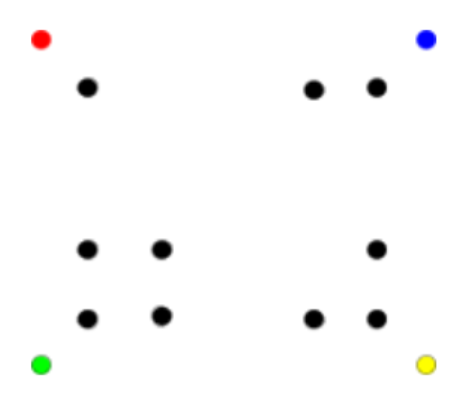
- Show the whiteboard map (upside down); ask what the dots represent
- Ask what's wrong; slowly rotate; students shout "Stop!" when it's oriented
- Spatial questions: "Which cone is closest to the red landmark?" "Which cones are between the yellow and green?"
- Geometric-O: pair up, receive maps, progress through levels
- Visit checkpoints in order, starting with the triangle
- Partner verifies with the animal clue sheet
- Progress to 10-checkpoint maps
- Repeat for speed, then from memory. When repeating solo, students self-check: confirm each checkpoint before moving on. 🧭 Checking
Reflection
- What was challenging about matching the map to the real space?
- What sort of mistakes did you make? How did you fix them?
- How did you know the map was oriented correctly?
- Describe the mental map you built of the space
Extensions
- Remove the colored landmark cones (harder orientation)
- Napkin-O: cover animal pictures with napkins; communicate with other pairs to finish
- Word Bank Orienteering: one partner reads the map, the other runs using only approved words
- Have students draw their own map of the space
- Have students design their own course on a map