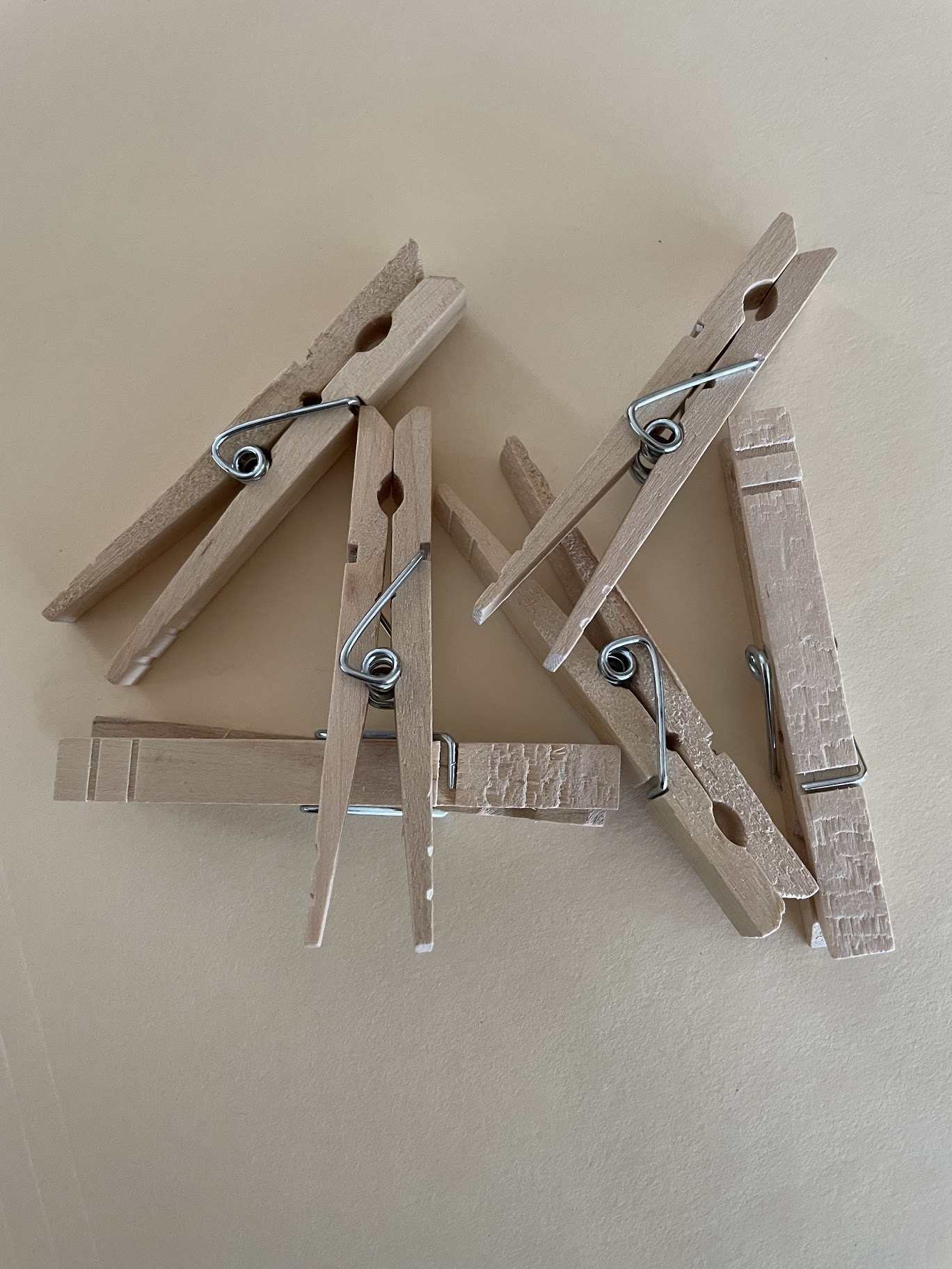

Clothespin-O — Activity
Find hidden objects and describe their locations
| Time | 30-45 minutes |
|---|---|
| Space | Any space (gym, schoolyard, or local park) |
| Materials | Clothespins (numbered, lettered, or with colored streamers), Small whiteboards and markers (optional, for map variations) |
| Vocabulary | Boundary, Clue, Treasure |
"Let's play orienteering games with clothespins!"
- Learning Goals
- How to Run It
- Reflection
- Script
- Vocabulary
Learning Goals
Students completing this activity will be able to:
- Follow instructions and search carefully within the boundary
- Practice observation and finding things in a defined space
- Communicate the location of a hidden object to a partner using spatial language
- Help others find their treasures after finding your own
How to Run It
Setup
- If playing the teacher-hides version, hide clothespins throughout the space before students arrive. Remember where each one is hidden
- If playing the partner version, give each pair a clothespin
- If playing the map version, draw a simple map of the space on a whiteboard ahead of time
Steps
1. Boundaries. Explore the boundary together. Quiz students on what is inside and outside the boundary.
2. Explain the game. "There are small objects hidden throughout this space. Your job is to search carefully, find a treasure, and bring it back to me. When you bring it back, you must tell me exactly where you found it."
3. Search. Students search within the boundary. When they find a clothespin, they bring it back and describe where they found it.
4. Help others. Once you have found one treasure, find a friend to help. Everyone gets a chance.
5. Hints. If some treasures are not found, provide hints to narrow the search area.
6. Variations. Once all treasures are collected, move to partner or map variations.
Adaptations
Ways to adapt the activity to meet the needs of your students: slow things down, increase the challenge, or adapt for different learners
- Teacher hides (simplest): teacher hides clothespins before the session. Students search and report where they found them
- Traveling Pairs: one partner hides, then travels with the finder giving only "warmer/colder" or "north/south/east/west" clues
- Limit the clues: restrict what the hider can say (e.g., one feature word and one describing word: "under bench")
- Picture/Map Treasure Hunt: draw a map of the space. Students mark where they found their treasure on the map. For a harder version, have students hide their own treasures and draw the locations for a partner to find
- Finders Keepers: hide a single treasure. Narrow the search area over time. Whoever finds it gets to hide it next
- Treasure Collectors: one student hides one treasure per classmate. The class must work together so each person collects exactly one. Challenge: can they do it without talking?
- Personal Treasure Hunt: write each student's name on a clothespin, hide them all. Students search for their own treasure. If they find someone else's, they help that person find it
- Team Treasure Hunt: divide treasures into color-coded groups. Teams race to find all their treasures before the other team
Tips
- Remind students: if you move any objects (chairs, toys, tables) while searching, put them back right away
- The "help others after finding yours" rule is important. It prevents some students from finding multiple treasures while others find none
- For the partner version, specify that clothespins must be reachable from the ground (no climbing trees, no burying)
- The map variation is a natural bridge to Geometric-O and later map activities
Reflection
- What made a good hiding place?
- Why is it important to follow the search rules carefully, like staying in the boundary and putting objects back where you found them?
- What makes a picture or map easy to understand? What makes it hard?
- What hints make the game more fun? What hints make the game less fun?
- How did you communicate with your partner about where the clothespin was?
- What strategies did you use to find the treasures?
- What makes a good helper? What is the difference between doing something for someone and helping them do it themselves?
- How do we share so that everyone gets a chance to have fun?
Script
Simple Version (Teacher Hides)
"Our challenge in this activity is to find clothespins hidden throughout the space. There are many ways we can play, but for now I've already hidden 15 clothespins. Once you find a clothespin, bring it to me and tell me where you found it."
"It's okay if you don't find a clothespin in the first round. You will have more chances to find clothespins."
Partner Version
"Find a partner. One person is the Hider, one person is the Finder."
"Finders, close your eyes. Hiders, go hide your clothespin somewhere in our play area. Once you have hidden it, come back and stand with your partner."
"Now, Finders can start searching. Hiders, you will travel with your partner and give them clues, but you can only say: warmer, colder. Or: north, south, east, west."
"After finding the treasure, switch roles."
Map Version
"We have a big map of our space with nothing drawn on it. I have hidden 10 clothespins around our play area. When I say go, search the area to find a clothespin. When you find one, bring it back and draw on the map where you found it. Then go help someone else."
Vocabulary
Boundary: The limits of the playing area. All treasures are hidden inside the boundary.
Clue: Information that helps someone find a hidden object. Clues can be verbal directions, spatial descriptions, or marks on a map.
Treasure: The hidden object you are searching for. In Clothespin-O, the treasures are clothespins.
See the Glossary for all curriculum terms.