Boundary Run — Activity
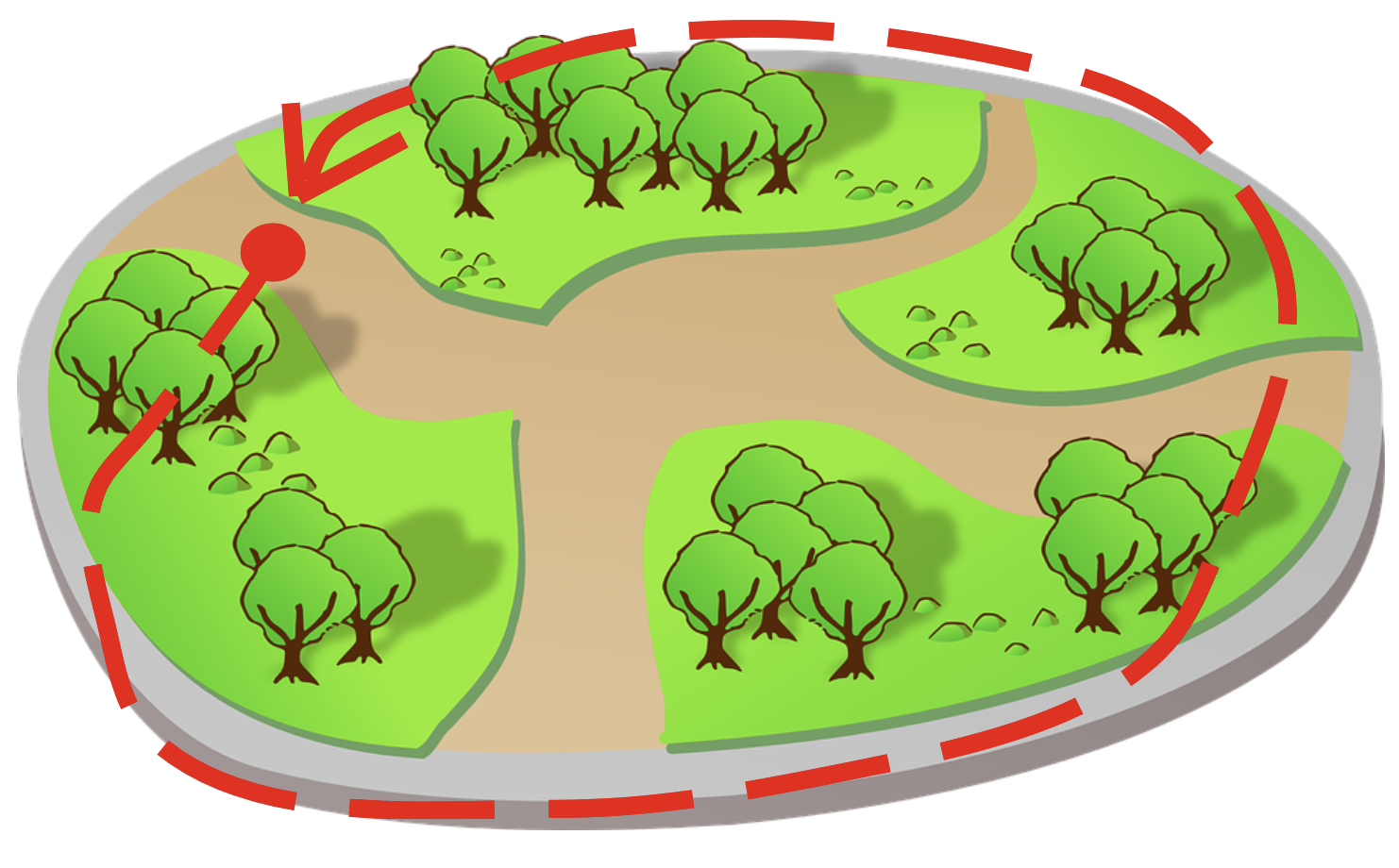
Travel the boundary of the play area
| Time | Walk the boundary + 5 min discussion |
|---|---|
| Space | Gym, schoolyard, or local park |
| Materials | Cones (optional, for marking boundaries) |
| Vocabulary | Boundary |
"In orienteering we stay inside a boundary"
- Learning Goals
- How to Run It
- Reflection
- Script
- Vocabulary
- Related Activities
Learning Goals
Students completing this activity will be able to:
- Identify the boundary of the play area after following the leader around it
- Tell whether landmarks and locations are inside or outside the boundary
- Recognize areas within the boundary that are still off limits (gardens, parking lots, etc.)
- Explain why boundaries matter for safety and respect
How to Run It
Setup
- Walk the space and identify the boundary you want to use
- If any edges are unclear, place cones to mark them
- Note any areas inside the boundary that should still be off limits (gardens, playground equipment, pond, etc.)
Steps
- Gather participants together at a starting point
- Explain that you will all run around the boundary together, and they need to pay attention to where you go
- Everyone must stay in single file behind the leader. This is an opportunity to practice spatial awareness and following instructions.
- Run around the boundary.
- After the run, quiz participants on the boundaries: point to or name landmarks and ask whether they are inside or outside the boundary
- If there are gardens or other off-limits areas within the boundary, ask whether participants should go there even though it is technically "inside"
Adaptations
Ways to adapt the activity to meet the needs of your students: slow things down, increase the challenge, or adapt for different learners
- Follow the leader: run the boundary together at the leader's pace
- Follow new leaders: have students trade off who is leading, once you've shown or explained where the boundary is
- For speed: repeat the boundary at a faster pace
- Different movements: skip, gallop, or hop along the boundary instead of running
- Why it matters: discuss why boundaries are important (safety, respect)
- Play a boundary game: try Hot or Cold, Shrinking Boundary Tag, or Capture the Flag (see Related Activities tab)
Tips
- Adjust your pace for the group. Be aware of varying physical abilities
- Establish a firm expectation from the start: participants must remain inside the boundary at all times during class
- If participants cannot run, use walking or wheelchair movement and adjust the boundary size accordingly
Reflection
- What does boundary mean?
- How did you know whether something was inside or outside the boundary?
- Why might an area be off-limits even though it's inside the boundary? (Example: a garden)
- How can crossing the boundary be dangerous?
- What are some things we see every day that mark boundaries? (Fences, curbs, signs, etc.)
- What are some examples of non-physical boundaries? (Personal, emotional)
Script
The Boundary Run
"Our challenge now is to follow me around the boundary of our space today. Everything we do will be inside the boundary, and I'm going to quiz you afterward about where we go, so be sure to pay attention!"
"There are only two rules for this game: you must follow me in single file, and you can't go in front of me at any time. It's like follow-the-leader!"
(Run the boundary. Point out key landmarks as you go.)
Inside/Outside Quiz
(Point to a landmark) "Is this inside or outside our boundary?" (Repeat with 2-3 examples)
(Point to an off-limits area like a garden or parking lot) "This is inside the boundary. Should we go there?" (Wait for "No!") "Why not?"
"So why do we have boundaries?" (Guide toward: safety and respect)
Vocabulary
Boundary: The perimeter of the play area. All checkpoints are inside the boundary.
See the Glossary for all curriculum terms.
Related Activities
Hot or Cold (extension)
One partner picks a secret spot and gives "warmer/colder" clues while the other searches for it, both staying inside the boundary. Reinforces communication and spatial awareness within the boundary. Takes 10-15 minutes with cones set out in a grid; pair up, swap roles when found, and add a second or third secret cone for more challenge.
Shrinking Boundary Tag (extension)
Play any tag variant while the boundary shrinks every few minutes; anyone caught outside the new boundary faces the tag consequence. Reinforces boundary awareness with added physical challenge. Takes 10-15 minutes with cones arranged in concentric circles; announce a 10-second countdown each time the boundary shrinks, continuing until playing within the smallest area.
Capture the Flag (extension)
Two teams defend territories on either side of a boundary line and try to steal each other's flag without getting tagged. Reinforces boundary awareness by giving the boundary a strategic purpose. Takes 15-20 minutes with a dividing line and 2 flags; tagged players go to a "jail" until freed by a teammate. Once students can read a map, try Capture the Flag-O, the same game with flags at mapped locations.