Lesson 3: Say Where
| Time | 30-45 minutes |
| Space | Gym, schoolyard, or local park |
| Materials | Small hidden objects (clothespins, colored cards, or small toys), Cones (optional, for marking boundaries), Clothespins (numbered, lettered, or with colored streamers), Small whiteboards and markers (optional, for map variations) |
| Setup | Hide objects around the space before students arrive; some easy to spot, some harder |
| Vocabulary | Boundary, Gathering signal, Clue |
Activities
warm-up
Boundary Run
Quick review of the boundary.
core
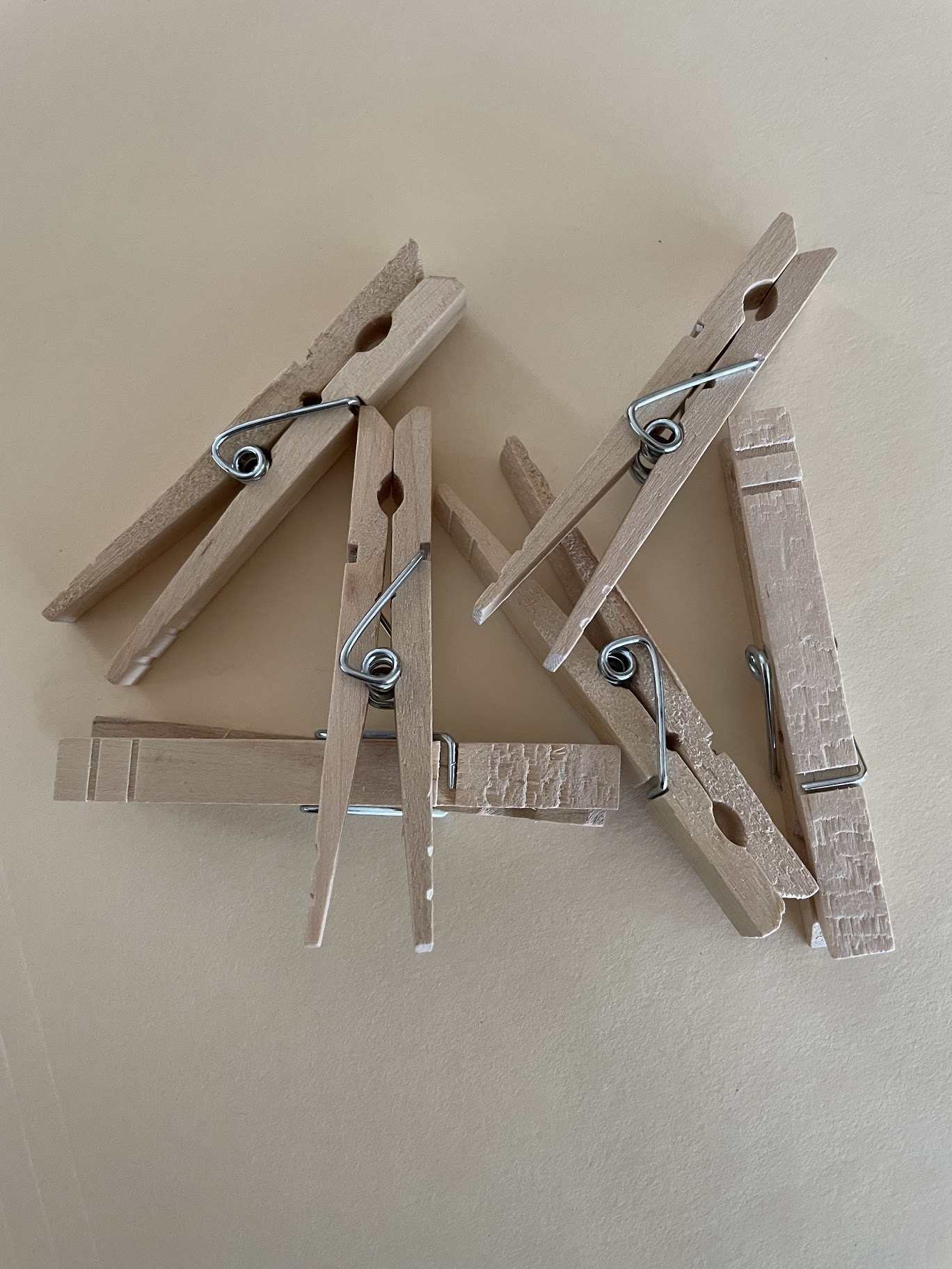
Clothespin-O
Find hidden objects and describe their locations.
Goals
Orienteering Goals
- Find hidden objects within the boundary
- Give and follow spatial language clues to find objects
PE Standards (SHAPE America)
Standard 1: Motor Skills
- Demonstrates a variety of locomotor skills with the concepts of space, effort, and relationship awareness (1.2.1). Students walk, jog, and run through the space searching for hidden objects.
Standard 2: Movement & Fitness Concepts
- Recognizes personal space and where to move in general space (2.2.1). Students navigate the shared space while searching, avoiding collisions with other searchers.
- Identifies movement concepts related to locomotor, non-locomotor, and manipulative skills (2.2.3). Students change speed and direction in response to clues, moving purposefully toward described locations.
Standard 3: Social Skills
- Uses communication skills to share space and equipment (3.2.3). Students describe treasure locations to the group using spatial language during report-back.
- Discusses problems and solutions with teacher support in a physical activity setting (3.2.8). Students discuss what makes a clue helpful or confusing and refine their descriptions.
See PE Standards alignment for the full framework.
Delivery
- Boundary Run: quick review of the boundary.
- Clothespin-O: "I've hidden treasures around the space. Your job is to find them, but don't touch them! When you find one, remember where it is."
- Students explore to find hidden objects. Return on the gathering signal.
- Report back: where did you find treasures? Practice spatial language: "It was behind the cone." "It was next to the door." "It was between the two trees." Which treasures were easy to spot? Which were tricky?
- Teacher models a clue: "There is a treasure near something red." Students go find it.
- Send out again with a new clue each round. After each round: "What made that clue helpful? Could you make it even better?"
- Hide and Describe. Students hide objects for a partner, then give spatial clues to help them find the treasures. No pointing!
- Collect the treasures and bring them back.
Reflection
- What words helped you describe where the treasures were?
- Was it easier to find a treasure with a clue or without one?
- Did you get better at giving clues? What changed?
Extensions
- Use "hotter/colder" clues instead of spatial words
- Teacher describes a location; everyone runs there ("Go stand next to the tallest tree inside the boundary!")
- Draw a simple map and mark where you found the treasures